
How much protein do you need when losing weight?
6 min read · Last reviewed
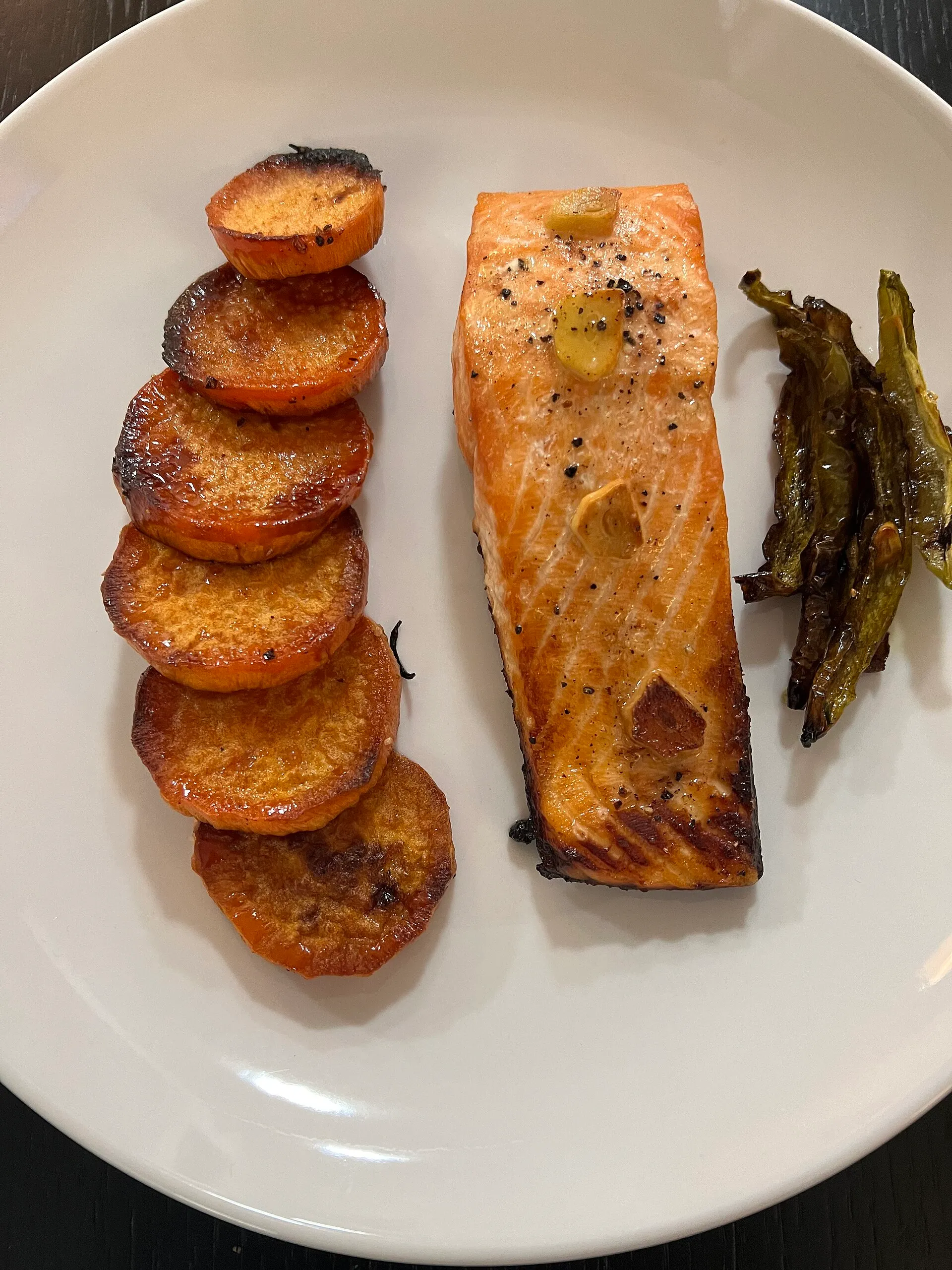
Most adults in a calorie deficit do well on about 1.2 to 1.6 grams of protein per kilogram of body weight a day, which is 84 to 112 g for a 70 kg person. People who lift weights and want to hold on to as much muscle as possible often aim higher, with research on athletes who are dieting suggesting 1.8 to 2.7 g per kg. The general minimum for adults, 0.8 g per kg, is a floor for health, not a target for dieting.
Why protein matters more in a deficit
When you eat less than you burn, your body draws on fat, and some of what it loses can be muscle. Protein is the food that gives the body raw material to keep that muscle. A review of protein in weight loss found that in short, tightly controlled studies, higher-protein diets led to greater weight and fat loss and better preservation of lean mass while people ate less.
Protein may also help you feel full. The same review found a modest effect on fullness after a single meal, but no clear effect on what people ate at the next one. It also says that results in longer studies were mixed, largely because people who followed the plan improved and people who did not, did not. Protein is a useful help, not a switch.
How much, in grams per kilogram
The figures below come from different kinds of evidence, so use them as ranges.
- 0.8 g per kg. The minimum that the National Academy of Medicine recommends for adults, as quoted by Harvard’s nutrition source. It is a baseline for avoiding deficiency, set for people who are not dieting.
- 1.2 to 1.6 g per kg. The range the protein and weight-loss review suggests may improve appetite and weight management, with at least about 25 to 30 g at each meal. This is the one to use if you do not train hard.
- 1.8 to 2.7 g per kg. The bodybuilding review quotes this as a range proposed for athletes training while eating less than they burn. It also describes a two-week trial in which athletes eating 2.3 g per kg lost 0.3 kg of lean mass, against 1.6 kg for those eating 1 g per kg. That is a small, short study of athletes, so it shows the direction, not your result. A meta-analysis of 49 trials of resistance training in healthy adults found no further gain in lean mass above about 1.6 g per kg a day, though those trials were not all done in a deficit.
- 2.3 to 3.1 g per kg of lean mass. The ISSN position stand says higher intakes may be needed to maximise muscle retention in lean, resistance-trained people who are dieting, and the bodybuilding review gives the same range for contest dieters. Both state it per kg of lean mass, not total weight. That is for already-lean athletes, not for most people reading this.
Trimlo’s own default is 1.8 g per kg of your current weight, and it never goes above 2.2. If that sounds high to you, the lower end of the range is reasonable, especially if you do not train.
| Body weight | 0.8 g per kg | 1.2 g per kg | 1.6 g per kg | 2.2 g per kg |
|---|---|---|---|---|
| 55 kg | 44 g | 66 g | 88 g | 121 g |
| 70 kg | 56 g | 84 g | 112 g | 154 g |
| 90 kg | 72 g | 108 g | 144 g | 198 g |
| 110 kg | 88 g | 132 g | 176 g | 242 g |
You can see what your own target looks like in the calorie and macro calculator.
If you have a lot of weight to lose
The tables above multiply by body weight, but the studies mostly involve people with less body fat than someone at 110 kg. The athlete research expresses protein per kg of lean mass for exactly this reason: muscle needs protein, fat tissue much less so.
No guideline we found gives a formula for this, so here is a practical rule, not an official one. Use a goal weight, or something between your goal and your current weight. A 110 kg person aiming for 90 kg can use 90 kg: 1.2 to 1.6 g per kg gives 108 to 144 g a day, not the 132 to 176 g that the full weight would give. The lower number is easier to hit, and it still sits inside the range the research supports.
What this looks like in food
A 70 kg person aiming for 1.6 g per kg wants about 112 g a day. At 25 to 30 g per meal, that is four protein-bearing eats, not one big steak.
From Harvard’s list: a 4 oz (about 115 g) skinless chicken thigh has 28 g of protein, a 4 oz piece of grilled salmon has 30 g, and a cup of cooked lentils has 18 g. A day might look like this:
- Lunch: chicken thigh with salad and rice, about 28 g.
- Dinner: salmon with vegetables and potatoes, about 30 g.
- Breakfast and snacks: the remaining 50 g or so from eggs, yoghurt, tofu, beans or a protein shake. Check the label, because amounts differ a lot between brands.
For a vegetarian day, lentils, beans and tofu do the same job, but you need larger portions. Two cups of cooked lentils give about 36 g.
If you are short, add a protein food to the meal you already eat, not a fifth meal. For portion sizes by eye, see counting calories without weighing your food.
Pair protein with training and a moderate deficit
Protein protects muscle best when the muscle has a reason to stay. Regular resistance training gives it that reason, and the meta-analysis above studied exactly that combination. Pace matters too: in a study the bodybuilding review describes, athletes losing 0.7% of body weight a week lost more fat (31% against 21%) and gained about 2% lean mass, while those losing 1.4% a week gained none. See how big a calorie deficit to aim for and what a safe pace is.
When to talk to a doctor first
Do not raise protein without advice if you have kidney disease. The NIDDK says some people with chronic kidney disease may need to limit protein to reduce waste buildup, that too little protein can cause malnutrition, and that people on dialysis may need more. Their advice is to set the amount with your doctor or a dietitian.
The same goes if you have another medical condition, take regular medication, are pregnant or breastfeeding, or have had an eating disorder. If you are unsure, ask a GP or dietitian to set a number for you.
Protein is one of the easier parts of a deficit to get right, and a rough target hit most days is enough.
Read next



Sources
- Leidy et al., The role of protein in weight loss and maintenance (Am J Clin Nutr, 2015)
- Aragon et al., International Society of Sports Nutrition position stand: diets and body composition (J Int Soc Sports Nutr, 2017)
- Helms et al., Evidence-based recommendations for natural bodybuilding contest preparation (J Int Soc Sports Nutr, 2014)
- Morton et al., A systematic review, meta-analysis and meta-regression of the effect of protein supplementation on resistance training-induced gains in muscle mass and strength in healthy adults (Br J Sports Med, 2018)
- Harvard T.H. Chan School of Public Health: Protein
- NIDDK: Eating & Nutrition for Chronic Kidney Disease