
How many calories do you burn a day? Finding your maintenance calories
6 min read · Last reviewed

Your maintenance calories are the amount you eat in a day when your weight stays the same. A calculator can estimate it in seconds, and for most adults the estimate lands in a useful range, but it is still a guess about one body. The reliable way to get your own number is to start with the estimate, log what you eat for two to three weeks, and let your weight trend correct it.
What maintenance calories are
Your body burns energy in three main ways: keeping you alive at rest, moving around, and digesting food. Add them up over a day and you get your total daily energy expenditure, often shortened to TDEE. If you eat that amount, your weight stays about the same. Eat less and it tends to fall, eat more and it tends to rise.
That number is also the starting point for any calorie deficit. Pick a deficit without knowing maintenance and you are subtracting from a guess.
How calculators estimate it
Most calculators, including ours, do two steps.
First they estimate the energy you burn at rest. The standard choice is the Mifflin-St Jeor equation from a 1990 study of 498 healthy adults whose resting energy use was measured directly. It uses your weight, height, age and sex. A systematic review of four common equations found it the most reliable, with the narrowest range of error, while warning that estimates for an individual can still be noticeably off.
Second they multiply by an activity factor. Trimlo uses 1.2 for a mostly seated day, 1.375 for a day on your feet and 1.55 for physical work. You choose the one that fits, and this is where a lot of the error comes in.
Here is what that looks like for two people.
| 70 kg woman, 165 cm, 35 years | 110 kg man, 180 cm, 40 years | |
|---|---|---|
| Resting estimate | 1,395 kcal | 2,030 kcal |
| Mostly sitting (1.2) | 1,670 kcal | 2,440 kcal |
| On your feet (1.375) | 1,920 kcal | 2,790 kcal |
| Physical work (1.55) | 2,160 kcal | 3,150 kcal |
Picking the wrong activity level moves the answer by 250 to 350 kcal a day. That is as big as a whole meal, so it matters which row is the honest one. If you are unsure, pick the lower row.
How wrong can the estimate be
The 1990 study reports that its equation explained about 71% of the differences in resting energy use between people. The rest comes from things the equation cannot see, such as how much of your weight is muscle. The review above puts it in practical terms: the equation is the best of its group, and individual errors are still possible.
A fair rule of thumb is to treat the result as a range of about 10% either side. For the 70 kg woman on her feet, that is roughly 1,730 to 2,110 kcal. Hold that range loosely, because the activity choice and the way you log food can move your real number outside it.
The calories you burn exercising are another soft spot. Most trackers overstate them, which is covered in how many calories exercise really burns and in the calories burned calculator.
How to correct it with your own data
Your weight and your intake are the two things you can measure. Together they tell you what your body is actually doing.
- Log everything for two to three weeks. Eat roughly the same amount each day, and include oils, drinks and snacks. The NHS calorie-counting page says to include cooking oil, spreads, sauces and drinks.
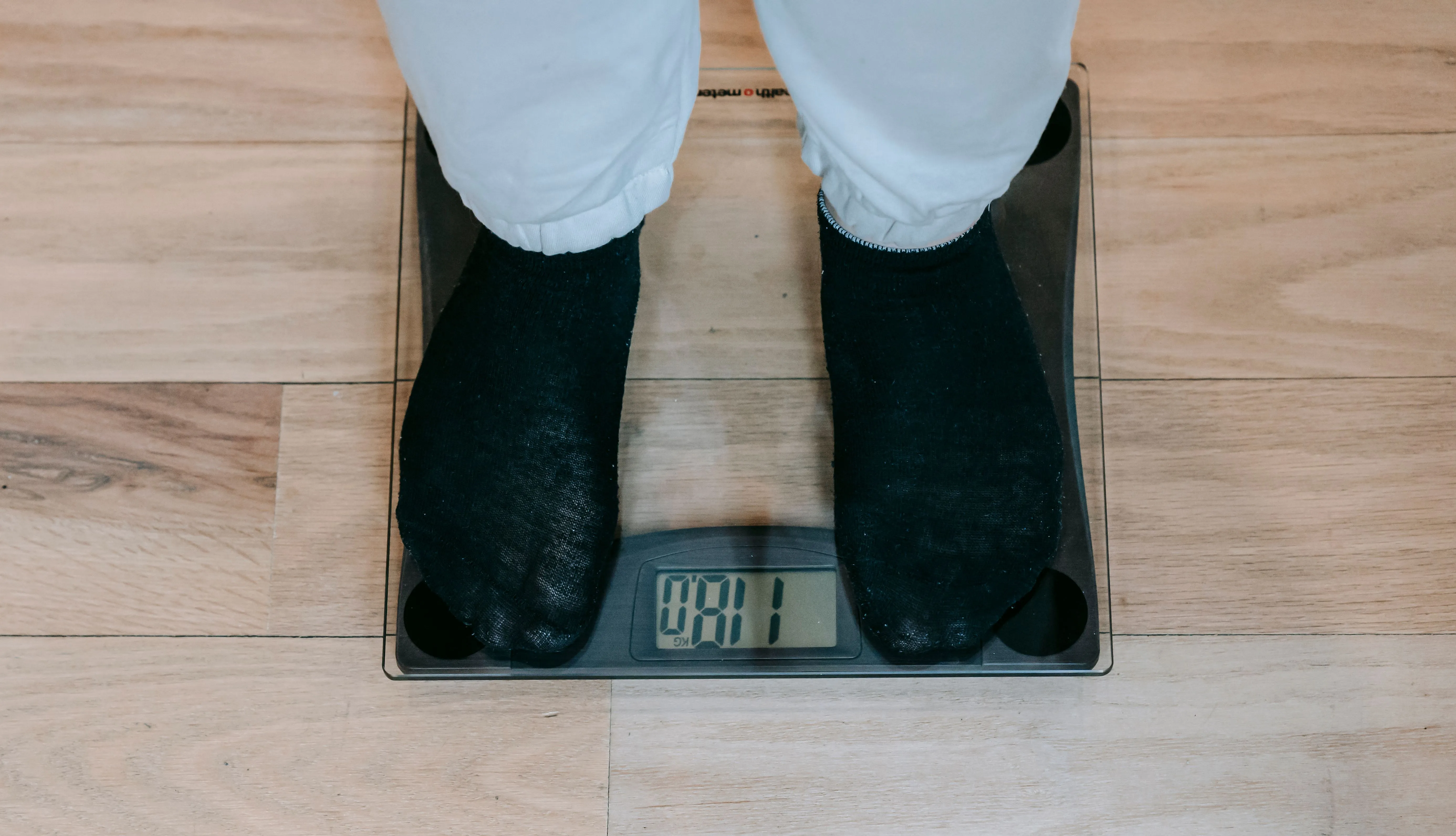
- Weigh yourself most mornings. Use the same scale, ideally after the toilet and before eating. A single reading is noisy, so look at the weekly average. Daily swings of a kilogram or so are mostly water.
- Compare the first and last week. If the weekly average has not moved, your average intake is your maintenance. If it has dropped, add back roughly 1,000 kcal a day for every kilogram a week you lost. That figure is a rough rule that Trimlo’s own goal maths uses. If it has risen, subtract the same way.
- Plan from that number. Subtract your deficit from the measured maintenance, not from the calculator’s guess.
Two examples:
- The 70 kg woman logged an average of 1,600 kcal a day for three weeks and her weekly average stayed at 70.1 kg. The calculator said about 1,920. Her measured maintenance, as she logs it, is about 1,600. A 600 kcal deficit from there is 1,000 kcal a day, not 1,320.
- The 110 kg man logged an average of 2,500 kcal for two weeks and lost 1 kg in total, about 0.5 kg a week. That is roughly 500 kcal a day below maintenance, so his maintenance is about 3,000 kcal, well above the 2,790 the calculator gave.
In the first example the gap could mean she burns less than the formula predicts, or that she eats more than she logs, or both. The practical answer is the same. In a classic study of ten people who said they could not lose weight on low intakes, measured energy use was within 5% of the predicted value, while their actual intake was about 47% higher than they reported. That was a small group, not a typical one, but it is a good reminder that a measured trend beats both the calculator and your memory. The number you find is maintenance as you log it, and that is the number to plan with.
Why your number changes
Weight loss lowers your maintenance. The NIDDK states that your metabolism slows down during weight loss, and a lighter body simply burns less. The same applies in reverse when you gain. Re-check your number after each 5 kg or so, or whenever your weight has stopped moving for three weeks.
The NIDDK also offers a free Body Weight Planner that shows how your weight may change over time as you change your intake or activity. It is a useful second opinion on the same question.
For why a stall is not always a failure, see why you may not be losing weight in a deficit.
When to get help
The method above suits healthy adults. If you have a medical condition, take regular medication, are pregnant or breastfeeding, or have had an eating disorder, set your intake with a GP or dietitian. Logging every calorie is not right for everyone.
Your maintenance is a number you measure over a few weeks, then keep checking.
Read next



Sources
- Mifflin et al., A new predictive equation for resting energy expenditure in healthy individuals (Am J Clin Nutr, 1990)
- Frankenfield et al., Comparison of predictive equations for resting metabolic rate in healthy nonobese and obese adults: a systematic review (J Am Diet Assoc, 2005)
- Lichtman et al., Discrepancy between self-reported and actual caloric intake and exercise in obese subjects (N Engl J Med, 1992)
- NIDDK: Body Weight Planner
- NIDDK: Eating & Physical Activity to Lose or Maintain Weight
- NHS Better Health: Calories and weight loss